Market Trends
The Moissanite Men's Jewelry Opportunity: What Retailers Should Stock
Men's moissanite is no longer a niche reserved for a handful of customers. Here is the wholesale stocking play for retailers.
For years, men's jewelry displays told a narrow story: plain bands, a few steel bracelets, and a two-stud rack. That story is changing. Male shoppers now walk into stores asking for something with a little more life on the hand, the wrist, and the ear, and moissanite has become one of the fastest answers. As a retailer, the question is no longer whether men will buy colored-stone jewelry, but how to stock it without tying up cash in the wrong SKUs.
The demand side is already visible. Engagement and wedding purchases pull men into the store, and once they are there, adjacent sales follow. A groom who buys a moissanite engagement ring for his partner is a warm lead for his own wedding band. Younger male buyers, particularly in the 25-to-40 bracket, are also seeking self-purchase pieces: small studs, signet rings, and single-stack bracelets that read casual but intentional. Moissanite fits this buyer because it is bright enough to notice, hard enough to survive daily wear, and priced so that a man can experiment without committing to mined-diamond money.
What actually sells for men
Three categories carry the volume, and each rewards a focused assortment rather than a wide scatter.
Screw-back moissanite studs
Studs are the gateway purchase. Men who do not yet wear jewelry almost always start with a pair. Stock round brilliant stones between 3mm and 5mm in 925 sterling silver or tungsten-style settings, and insist on screw-backs rather than push-backs. Push-backs fall out during workouts and travel, and a lost stud is a return and a bad review. A 4mm pair in a clean white stone is the sweet spot for first-time buyers.
Channel-set and bezel-set wedding bands
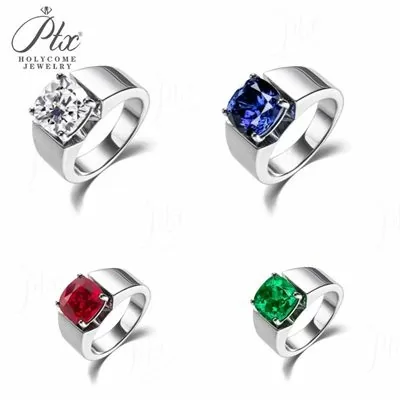
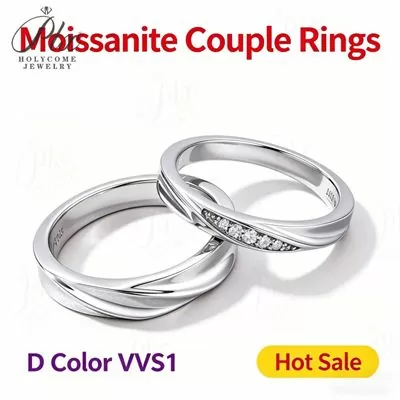
Prong settings look delicate on a man's hand and catch on gloves and keyboards. Channel and bezel settings protect the stones and read as rugged. A band with a continuous row of 1.5mm to 2mm moissanite stones in matte or brushed finish gives a groom something distinctive that still photographs like a classic white-metal band. Widths between 6mm and 8mm fit most male hands without overwhelming them.
Signet and pinky rings
The signet ring has returned as a men's fashion staple. A small bezel-set moissanite in a square or oval signet face offers a modern twist on a heritage shape. These are lower-volume but higher-margin pieces, and they attract the self-purchase shopper who is not in the store for a wedding at all.
Why moissanite over diamond for this buyer
Men tend to be value-focused and somewhat utilitarian when they buy jewelry. They want something that looks good but will not flinch at a gym session, a workbench, or a weekend outdoors. Moissanite ranks second only to diamond on the hardness scale, resists scratching far better than white sapphire or cubic zirconia, and carries a price tag that lets a buyer choose a bigger stone than he could ever afford in diamond. It is also conflict-free and lab-created, which matters to a growing share of male shoppers who care about provenance.
Stocking and merchandising tips
Do not bury men's moissanite in the bridal case. Build a small, dedicated men's wall or tray near the exit, where husbands and boyfriends can browse without feeling watched. Group studs by size, bands by width, and keep the pricing visible. Size assortment on bands should skew toward the larger end; men's ring sizes cluster between 9 and 11, while women's skew smaller. Carrying extra half-sizes in that range reduces special-order delays.
For retailers who want depth, working with a wholesale supplier that can supply loose moissanite and mount them to order opens custom widths and finishes without a huge inventory bet. Start with a tight run of bestsellers, watch the sell-through for 60 days, then reorder the shapes that move.
Price points that work
Men's jewelry buyers are price-sensitive in a different way than bridal shoppers. They rarely browse for hours; they want a confident recommendation at a price that does not require a decision. Studs in the $40 to $80 retail range move fastest, because they feel like an experiment rather than an investment. Wedding bands with a line of stones sit in the $150 to $300 range, where a groom can match his partner's ring without doubling the wedding budget. Signet and pinky rings are the discretionary tier, priced higher and bought by self-purchasing men who already know what they want. Stock to those three bands rather than trying to cover every price in between.
One practical note: men's pieces sell better when priced cleanly. Avoid the awkward psychological pricing that works in fashion; a man standing at the counter wants a round number he can hand to a salesperson without hesitation. Round prices also make the BNPL split look simpler if you offer financing.
The men's moissanite category is still early enough that a thoughtful small assortment can become a point of difference. Stores that treat it as a real department, rather than an afterthought on a bottom shelf, will capture the customer before he buys online.
Authoritative References
For buyers who need to verify the technical and regulatory basis of this guide, the following independent institutions publish authoritative reference data:
- FTC Advertising FAQs - U.S. guidance on truthful marketing and disclosure.
- Wikipedia: E-commerce - online retail and marketplace background.