
A certificate is only useful if it is tied to a specific stone. This page explains what each document covers, what it does not cover, and the verification steps we perform before your parcel leaves the factory.
The laboratories we work with
| Laboratory | Typically used for | What the report states |
|---|---|---|
| IGI | Lab grown diamonds, bridal centre stones | Carat weight, measurements, colour, clarity, polish, symmetry, fluorescence, growth method, treatment status, girdle inscription number |
| GRA | Moissanite, volume lines | Material identification with stated colour and clarity; a material statement rather than a full grading report |
| GIA | Higher-value stones on request | Full grading report with the strongest consumer recognition |
| NGTC | Buyers selling into mainland China | Domestic grading and identification documentation |
Documents included with every shipment
- Commercial invoice stating goods, quantity, unit value and country of origin
- Packing list with SKU, quantity, net weight and certificate number on each line
- Certificate copies matched to the stones supplied, plus photographs of the girdle inscription where applicable
- Material declaration covering metal content and plating chemistry
- Nickel-release test report on request, per production batch, for prolonged skin-contact items
- Conformity or test documentation for REACH-relevant parameters where your market requires it
Our quality-control sequence
- Incoming inspection. Stones are checked against the order sheet for colour, clarity and measurement before setting begins.
- Setting inspection. Every setter's output is checked for prong security, stone seating and surface damage before it advances.
- Final inspection at 10×. Polish quality, plating coverage, stone alignment, clasp and hinge function, and hallmark legibility.
- Metal verification. XRF analysis on a sample per batch to confirm alloy composition and plating thickness.
- Cleaning and packing. Ultrasonic and steam cleaning, then individual bagging so stones cannot contact each other in transit.
We do not ship a parcel where the certificate cannot be matched to the stone by number, photograph and measurement. If we cannot evidence it, we do not claim it.
How to verify a certificate yourself
- Enter the report number into the issuing laboratory's online lookup and confirm weight and measurements match.
- Compare the millimetre dimensions with callipers rather than relying on carat weight alone.
- Check that the girdle inscription photographs match the report number.
- Confirm that the certificate number appears against the correct line on your packing list.
- If you use a gemmologist, ask them to screen the growth method independently on a sample stone.
Compliance for regulated markets
For the European Union and the United Kingdom, the relevant requirements for jewellery are nickel release limits for prolonged skin contact, restrictions on lead and cadmium, and — for children's jewellery — additional chemical testing. We supply the documentation your customs broker and retail partner will ask for, and we recommend testing per batch rather than per design because plating chemistry can drift between runs.
How we handle certificate-to-stone matching
On certified lines, stones are graded before setting and the certificate number is recorded against the order line. At packing, we place certificate copies with the corresponding stones and list the number on the packing list. Where the stone is large enough for a girdle inscription, we photograph the inscription under magnification and include the image in your documentation pack. This is the evidence chain a retail partner will ask for if a customer queries a stone.
Testing beyond gemmology
Gemstone documentation is only half of jewellery compliance. Metal components carry their own obligations, particularly for prolonged skin contact. We supply a material declaration listing the alloys used in the band, posts, clasps and plating baths, and we can arrange nickel-release testing per production batch at an accredited laboratory for buyers selling into the European Union and the United Kingdom. Where a market restricts lead, cadmium or phthalates, we can consolidate those parameters into a single test report so your broker works from one document.
What certification does not cover
A gemmological report grades a stone. It says nothing about the setting's metal content, the plating thickness, the prong security or whether the piece will survive daily wear. Those are manufacturing attributes, and they are controlled by our own quality gates rather than by a laboratory. Buyers who treat a certificate as a complete quality guarantee frequently discover the difference at the returns stage — which is why we publish our QC sequence alongside our certificates.
Documents we hold
These are the actual reports and registrations behind the claims above. They were issued to our manufacturing operation, and the document numbers and dates are legible on the originals. If you need a copy covering a specific material or SKU before you place an order, ask us and we will send it with your quotation.
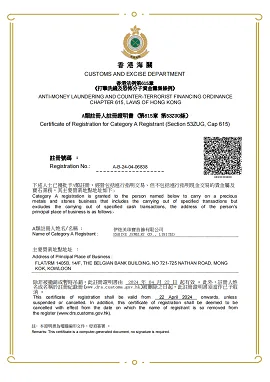
Anti-money-laundering registration held for our trading entity.
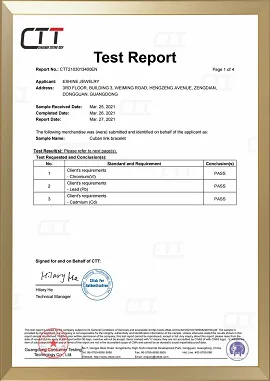
Nickel release, lead and cadmium testing on finished pieces.
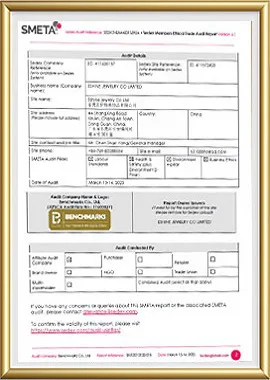
Independent audit covering labour standards and site conditions.
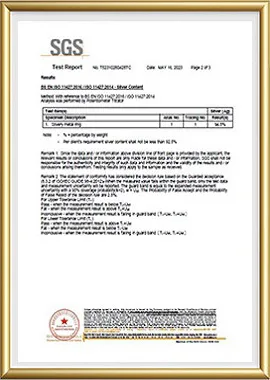
Elemental analysis against EU and US jewellery safety limits.
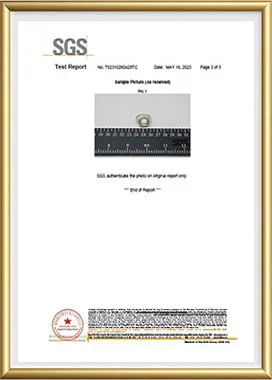
Sample record page held on file with the original report.
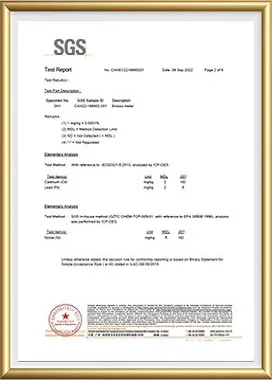
Elemental analysis for a production batch.
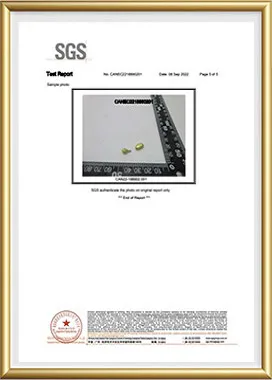
Finished-piece test report issued for a production run.
Reports shown were issued to our manufacturing operation. We do not publish a report that our material failed — only current, passing documentation is listed here.