Buying Guides
Moissanite vs Cubic Zirconia: Cost and Positioning
Moissanite and CZ sit at different price points for good reasons. A cost and durability comparison for buyers deciding what to stock, including where each stone fails in service and how to position both without confusing customers.
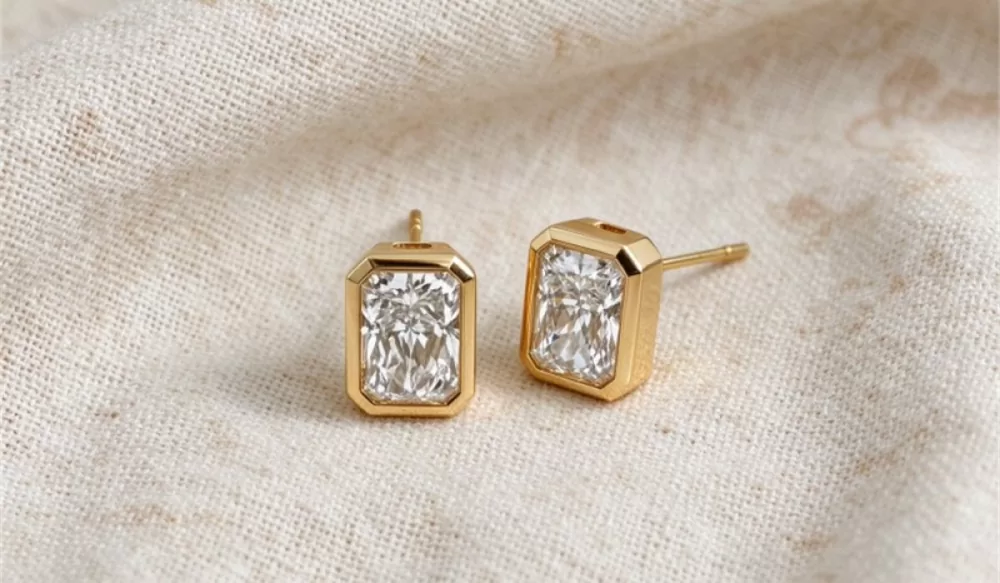
Moissanite and cubic zirconia are both laboratory-created, both inexpensive relative to diamond, and both frequently sold as the diamond alternative. Commercially they are not interchangeable: they carry different unit costs, different service lives and different customer expectations. Stocking the wrong one in the wrong place is a returns problem waiting to happen.
Specification comparison
| Property | Moissanite | Cubic zirconia |
|---|---|---|
| Hardness, Mohs | 9.25 | 8.0 to 8.5 |
| Refractive index | 2.65 to 2.69 | 2.15 to 2.18 |
| Dispersion, fire | 0.104, very high | 0.058 to 0.066, moderate |
| Typical wholesale unit cost | Mid | Very low |
| Colour stability | Stable, colour is grown in | Stable, but the surface dulls with wear |
| Edge retention on faceting | Excellent over years | Abrades and rounds within months of daily wear |
| Cleaning tolerance | Ultrasonic and steam safe | Ultrasonic safe; steam and harsh chemicals not advised |
| Certification | GRA common; in-house sheet for melee | Rarely certified individually |
| Typical retail positioning | Accessible bridal, anniversary, self-purchase | Fashion, costume, gifting, sample lines |
Why the durability gap matters more than the price gap
The cost difference between moissanite and CZ is real but small at wholesale, often a few dollars per piece on a silver ring. The service-life difference is large. CZ abrades at the facet edges, and after several months of daily wear the stone reads visibly duller in a side-by-side comparison with a new piece. In a fashion line that is acceptable, because the customer bought a look for a season. In a bridal or everyday-wear line it generates returns and poor reviews.
- Use CZ for: fashion and costume lines, trend-led designs with a short shelf life, colour-play designs where the stone is decorative, and photography samples.
- Use moissanite for: engagement and bridal, anniversary and milestone gifts, tennis bracelets and eternity bands, and anything marketed as everyday wear.
- Do not mix them in one product line without clear labelling. If a customer cannot tell which stone they are buying, the first complaint defines your brand.
Unit cost drivers, line by line
| Cost component | Moissanite | CZ |
|---|---|---|
| Raw stone material | Moderate, grown over weeks | Very low, high-volume production |
| Cutting effort | High; moissanite is hard and slow to facet | Low; soft material cuts quickly |
| Calibrated melee sorting | Significant labour share | Low labour share |
| Setting labour | Same as CZ | Same as moissanite |
| Metal cost | Dominates silver pieces | Dominates silver pieces |
| Certification | GRA per stone above 0.50 ct | Usually none |
Note the pattern: on a 925 silver piece, metal and labour dominate. That is why a CZ and a moissanite version of the same ring often differ by less than the customer assumes, and why upgrading from CZ to moissanite is frequently the highest-margin move available on an existing design. You change one line of cost and one line of retail price.
The upgrade path that works
- Launch a design in CZ at an entry price to test demand and photography.
- If it sells, release the moissanite version of the identical silhouette at a higher price point.
- Offer the moissanite version in 10K or 14K gold as a third tier.
- Keep the CZ entry piece as the traffic driver and use it to upsell in person.
How to describe both without misleading
| Say this | Not this |
|---|---|
| Laboratory-created moissanite, 9.25 Mohs, GRA certified | Real diamond alternative, with no material named |
| Cubic zirconia, a fashion stone for occasional wear | Implying CZ will look the same in two years |
| Identical appearance at a fraction of the cost | Any claim of resale or investment value |
| Hardness 8.0 to 8.5; remove before swimming or cleaning | Omitting care instructions to avoid a sale objection |
Detecting moissanite and CZ in the trade
A standard thermal diamond tester will read moissanite as diamond, because their thermal conductivity overlaps. Two cheap tools solve the problem. A multi-tester that measures electrical conductivity as well as thermal will separate moissanite from diamond reliably. A simple magnifier and a scale of reference stones will separate CZ from moissanite: CZ has noticeably less fire and a slightly softer, more plastic-looking lustre in a side-by-side comparison under the same light.
| Test | Diamond | Moissanite | CZ |
|---|---|---|---|
| Thermal tester | Positive | Positive (false positive) | Negative |
| Multi-tester, electrical | Positive | Negative | Negative |
| Fire under a point light | Moderate | Very high, rainbow flashes | Low to moderate |
| Facet edge condition after wear | Sharp | Sharp | Rounded and dulled |
| Inscription under 10x | Report number | Often none | None |
Verify against the certificate inscription rather than relying on any tester alone, particularly on returns and resale. A tester tells you what the material is; the inscription tells you whether the specific stone you are holding is the one that was graded.
Stocking ratio that works in practice
Across the trade accounts we supply, the ratio that performs is roughly 60 to 40 by unit volume in favour of CZ for fashion-led catalogues, and 80 to 20 in favour of moissanite for bridal-led catalogues. The mistake is stocking only one: CZ-only catalogues have no upsell ladder, and moissanite-only catalogues have no affordable entry point for a new customer.
Reading a loose stone supplier quotation
Parcel quotations are quoted either per carat or per piece, and the difference matters when you compare suppliers. Per-carat pricing looks cheaper on small melee because the piece count is high, while per-piece pricing is clearer on larger stones where the carat weight varies. Always ask for both figures on a parcel, plus the total carat weight, so you can normalise the comparison.
| Quotation format | Best used for | Watch out for |
|---|---|---|
| Per carat | Melee parcels where size is tightly sorted | A wide size range inflates total carat while the average stone shrinks |
| Per piece | Calibrated melee and single stones | Silence on average carat weight, which hides a lighter parcel |
| Per parcel | Mixed old-stock lots | No size breakdown at all, so you cannot plan a setting run from it |
Three questions turn a loose stone quote into something you can compare: what is the actual measured size range, what is the total carat weight, and what is the piece count. A supplier who answers all three promptly is operationally organised. One who answers only the price is telling you that the parcel documentation will also be thin.
Replenishment planning for a stone supply
- Hold one master parcel per specification under your own SKU reference, and grade every reorder against it rather than against the specification sheet alone.
- Set the reorder point in carats, not pieces, because your consumption across a production run is driven by total carat weight.
- Order melee and centre stones on the same cycle where possible, so a production run is not held up waiting for a single component.
- Record the actual size range on every parcel sheet you receive, not just the nominal size. That record is what lets you diagnose a channel that stops seating properly three months later.
Related Articles
- 10K vs 14K vs 18K Gold: A Manufacturing Guide for Buyers
- Lab Grown Diamond Traceability: What Buyers Should Demand
Authoritative References
For buyers who need to verify the technical and regulatory basis of this guide, the following independent institutions publish authoritative reference data:
- ISO 9001 Quality Management - the international standard for consistent production quality.
- Wikipedia: Jewellery - manufacturing processes, materials and global trade background.