Wholesale Sourcing
Jewelry Trend Forecasting: What to Stock for 2026
Trend forecasting is not about predicting the next big thing. It is about reading the data and testing small before you commit.

Every wholesale buyer wants to know what will sell next season. The truth is that trend forecasting in jewelry is not about predicting the next viral style. It is about reading the signals - runway, social media, sell-through data - and testing small before you commit inventory. The buyers who win are not the ones who predict trends perfectly. They are the ones who test a trend with 20 pieces, see if it sells, and reorder if it does.
Where trends actually come from
Jewelry trends move through a pipeline. The runway shows set the direction. Fast fashion brands (Mejuri, Missoma, Aster) popularize it. Social media (TikTok, Instagram) amplifies it. By the time a trend hits the wholesale catalog, it is already six months into its lifecycle. Buyers who wait for the catalog are late. Buyers who watch the runway and the DTC brands are early.
| Signal | Lead time to retail | How to read it |
|---|---|---|
| Runway shows | 12-18 months | Direction, not product |
| DTC brand launches | 6-9 months | Specific styles to watch |
| TikTok / Instagram trends | 3-6 months | What is actually selling now |
| Your own sell-through | Real time | The most reliable signal |
What is rising in 2026
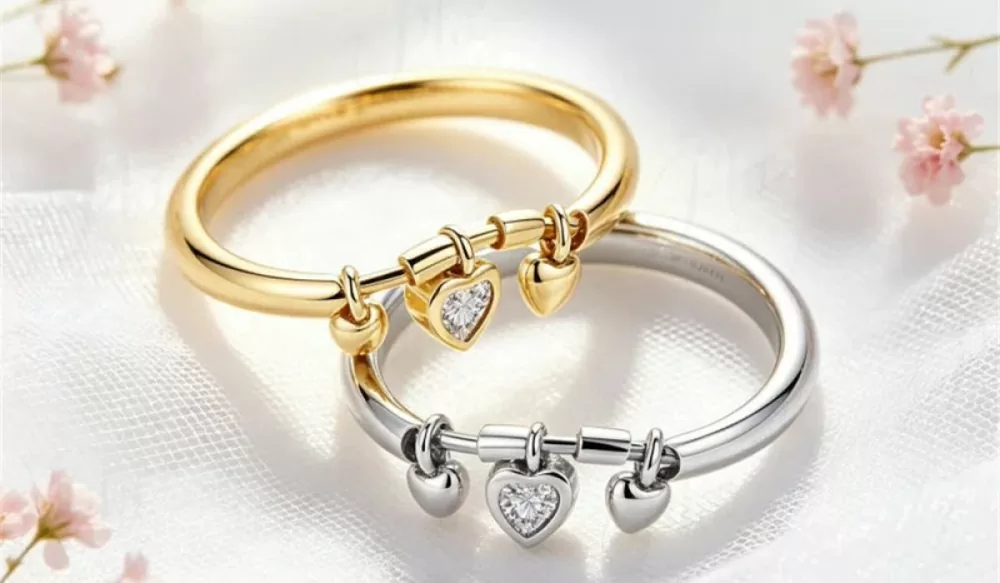
Three directions are showing up across DTC brands and runway in 2026. First, sculptural and organic forms - irregular pearls, wavy bands, asymmetrical earrings. Second, personalized and engraved pieces - not just names, but coordinates, Roman numerals, and small meanings. Third, mixed metal stacking - wearing gold and silver together, which used to be a faux pas and is now a style. These are not fads; they are shifts that will hold for a few seasons.
What is fading
The minimalist thin-band look that dominated 2019-2023 is maturing into a classic, not a growth category. It still sells, but it no longer grows. The huge pavé statement necklaces of the early 2020s have faded. Customers now prefer smaller, more personal pieces. Do not overstock the fading categories; keep them as baseline inventory, and put the new buy into the rising ones.
How to test a trend without overstocking
The mistake buyers make is committing 500 pieces to a trend on a hunch. The right way is to test 20-50 pieces, sell them through, and reorder if they move. A trend that sells 30 of 50 pieces in 60 days is a real trend. A trend that sells 5 of 50 was a hunch. The cost of the test is $500-$1,000. The cost of overstocking a failed trend is $10,000+.
Building a trend-tested collection
A healthy wholesale collection is 70% proven evergreen SKUs and 30% trend-tested new pieces. The evergreen SKUs pay the bills. The trend pieces keep the catalog fresh and bring in new customers. Buyers who go 100% evergreen have a stale catalog. Buyers who go 100% trends have dead stock. The 70/30 mix is the balance.
The 2026 demand drivers
Underneath the style trends, three demand drivers are shaping what sells in 2026. First, the return-to-office trend is lifting demand for everyday wearable pieces, not just statement pieces. Second, the bridal market is shifting to smaller, more personal engagement rings as budgets tighten. Third, the male jewelry market is growing faster than the female market for the first time in a decade. Each driver points to a different stocking strategy: everyday silver for the office, smaller lab diamonds for bridal, and chains and signet rings for men. Build the buy around these drivers, not around the catalog.
The quarterly trend review
Run a quarterly trend review on your own sell-through. Pull the sales data for the last 90 days. Which SKUs sold out? Which sat? The data tells you more than any runway report. A style you stocked on a hunch that sells 40 of 50 pieces is a real trend. A style you stocked on a trend report that sells 5 of 50 was a guess. The quarterly review replaces the guesswork. After three quarters, you will know your customer better than any trend forecaster.
The trend lifecycle
Every trend has a lifecycle. It rises for 6-12 months, peaks for a season, and fades over 6-12 months. The buyers who make the most money are the ones who enter the trend early, sell through the peak, and exit before the fade. The buyers who enter at the peak are the ones left with dead stock. Watch the sell-through data for the turn. When a style that was selling 40 of 50 now sells 15 of 50, the trend is fading. Stop reordering. Clear the remaining stock. Move on to the next trend.
We help buyers test new trends with small first orders and reorder on proven sell-through. More on how we structure trend orders is on the wholesale sourcing page. Trend forecasting is not a crystal ball. It is a testing process: watch the signals, buy small, reorder what sells.
Authoritative References
For buyers who need to verify the technical and regulatory basis of this guide, the following independent institutions publish authoritative reference data:
- ISO 9001 Quality Management - the international standard for consistent production quality.
- Wikipedia: Jewellery - manufacturing processes, materials and global trade background.