Moissanite
Buying Moissanite Halo Engagement Rings Wholesale: What Retailers Need to Check
Halo rings sell on visual size, but the wholesale quality gaps hide in the micro-prongs and the gallery. This checklist covers what to inspect before approving a halo bulk order.
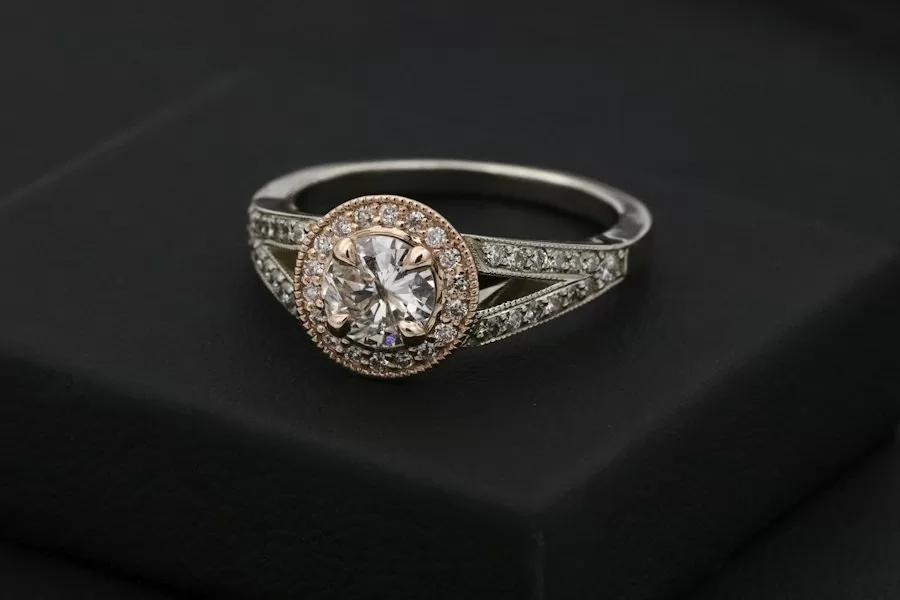
The halo engagement ring is the most photographed moissanite style on social media, and for good reason: a well-built halo makes a 1 ct center stone read as a 1.5 ct on the finger. That optical trick is the entire sales story, and it is why halo rings now outsell plain solitaires in many mid-price bridal categories. But the wholesale quality problems in a halo are invisible until the customer wears the ring for a month, at which point the warranty clock is already running.
The center stone is not the weak point
In most halo returns, the center stone survives and a halo melee stone falls out. The surrounding ring of tiny moissanites is held by micro-prongs so small that a jeweler's loupe barely resolves them, and factory finishing on these prongs varies widely between suppliers. When you approve a sample, inspect the halo stones at ten-power magnification. Every stone should sit level, every prong should be closed over the girdle, and no stone should wobble under light pressure. If you see even one loose halo stone on the sample, reject the production run; the rest will follow.
Two-rhythm versus one-rhythm halos
A single-row halo is the classic style and the most repairable. A double-row halo looks more lavish on a model hand but doubles the number of micro-prongs and roughly doubles the long-term repair workload. For a retailer, the single-row halo is the safer buy because a local jeweler can re-tip a loose stone in minutes. The double-row halo is a made-to-order piece, not a stock piece. If you want to offer it, do so on a custom basis rather than tying up shelf inventory.
Band width and comfort fit
Halo rings need a slightly wider band than solitaires because the setting carries more visual weight. A 2 mm shank reads as balanced under a halo; a 1.5 mm shank looks delicate and flops on the finger. Ask for comfort-fit inside edges, which reduce the "this ring spins" complaint that comes up more often with wide settings. Also check that the shoulders of the band flow smoothly into the halo, not with a visible step.
The gallery and the under-gallery
The open space under the center stone is where light enters and makes moissanite sing. A poorly finished gallery with thick support bars blocks that light and makes the center stone look dark. Look through the top of the ring at eye level; you should see open air under the stone, not a solid web of metal. This is also where customers look when they compare your ring to a competitor's, so the finish matters optically as much as structurally.
Plating and rhodium thickness
A halo ring is sold on sparkle, and dull rhodium kills sparkle fast. Insist on a three-micron rhodium dip, not the standard one micron that factories default to. The extra plating costs a small amount per ring but keeps the white look for two to three years instead of one. Yellow-gold and rose-gold vermeil halos sell well as fashion-forward bridal alternatives; stock one of each even if white is your core. Our guide to silver ring plating options walks through the thickness tradeoff.
Sizing
Halo rings can be sized, but sizing a halo warps the outer ring if the jeweler heats it carelessly. Tell your local repair shop which supplier you buy from so they know how much heat the setting tolerates. Buy stock in US 6, 6.5, 7, 7.5, 8 and size down or up at point of sale rather than trying to cover every half size.
Pricing and margin
Wholesale cost for a 1 ct center moissanite single-row halo in 925 rhodium is low enough that retail lands in the $300 to $600 band, which is the sweet spot for younger engagement buyers. That price undercuts a 1 ct lab-grown diamond halo by a wide margin while delivering the same visual effect. For more on how shoppers compare moissanite to lab-grown at retail, read our moissanite versus lab-grown piece.
Certificate and disclosure
Each halo ring should ship with a GRA or equivalent card for the center stone. FTC disclosure rules require the tag to state "moissanite," not "diamond." Mislabeling a halo is a common compliance slip because the visual reads so diamond-like; get the tag wording approved before bulk arrives.
Start with one halo shape
Round center stones with round halos are the safest first buy. Oval halos are a strong second if your market skews modern. Avoid cushion and pear halos for the opening order; they convert well once you know your customer, but they are a reorder decision, not a first-order decision. Display the halo on a rotating bust so customers see the flash from every angle; that motion sells the piece faster than a static tray.
A halo ring lives or dies on micro-prong finish and rhodium thickness. Inspect the sample under magnification, demand the thicker plating, and stock the repairable single-row version before you chase the double-row look.
Authoritative References
For buyers who need to verify the technical and regulatory basis of this guide, the following independent institutions publish authoritative reference data:
- GIA Gem Encyclopedia - independent grading and identification reference for natural and lab-grown gems.
- Wikipedia: Moissanite - peer-reviewed background on moissanite chemistry, optics and history.