Moissanite
The Moissanite MM-to-Carat Equivalent Size Chart for Retailers
Moissanite is not sold by carat weight—it is sold by millimeter diameter. Once your team knows the conversion, customer size conversations get a lot easier.
A customer walks in, points at a ring, and asks whether it is a one-carat. The correct answer for a moissanite retailer is not yes or no—it is a millimeter. Moissanite is manufactured and sold by diameter in millimeters, not by carat weight, because the synthetic crystal is produced in calibrated round sizes. Yet bridal shoppers still think in carats, because that is how diamonds are sold. The gap between how the trade describes moissanite and how customers shop for it is where confused quotes, wrong-sized orders and frustrated buyers happen. This chart closes that gap.
Why moissanite is measured in millimeters
A natural diamond's carat weight comes from its actual mass, and two one-carat diamonds can measure slightly differently depending on cut proportions. Laboratory-grown moissanite is produced to exact millimeter standards—5.0mm, 6.5mm, 7.5mm and so on—so the supplier and the setter always know the stone will fit a standard head. Because moissanite is less dense than diamond, a 6.5mm moissanite weighs less than a 6.5mm diamond, which is why quoting it by carat weight is misleading. The trade quotes by mm; customers think in diamond carat equivalents.
The standard round equivalent chart
Retailers should keep this conversion taped near the counter:
- 5.0mm reads like about a 0.50 carat diamond equivalent
- 5.5mm reads like about a 0.60 to 0.70 carat equivalent
- 6.0mm reads like about a 0.80 carat equivalent
- 6.5mm reads like about a 1.0 carat equivalent
- 7.0mm reads like about a 1.25 carat equivalent
- 7.5mm reads like about a 1.5 carat equivalent
- 8.0mm reads like about a 1.75 to 2.0 carat equivalent
- 9.0mm reads like about a 2.5 to 2.7 carat equivalent
- 10.0mm reads like about a 3.0 to 3.5 carat equivalent
These are visual equivalents—how the stone reads on the hand at a glance—not the moissanite's actual carat weight, which is lower. Staff should say it looks like about a one-carat diamond rather than calling it one carat, which keeps expectations honest and prevents a customer from feeling misled.
How this affects your wholesale buying
When you order loose moissanite or mounted rings, you buy by millimeter, and that changes how you think about stock depth. The 6.5mm round is the volume SKU—it is the engagement-ring standard, the one that matches the iconic one-carat look. A smart wholesale buy anchors on 6.5mm, then adds 5mm for daintier fingers and 7.5mm for the customer who wants presence. This is the same stocking logic discussed in loose stones versus mounted rings: loose calibrated stones let you set into customer-chosen heads, while mounted rings come pre-sized to standard diameters.
Price tracks with diameter, and the jump from 6.5mm to 8mm is larger than from 5mm to 6.5mm, which is why understanding moissanite pricing structure matters before you quote a customer a 2.5-carat-equivalent ring. The price difference between a 1ct-equivalent and a 2ct-equivalent stone is not double; it is a step function in the millimeter ladder.
How ring size and finger shape change the visual
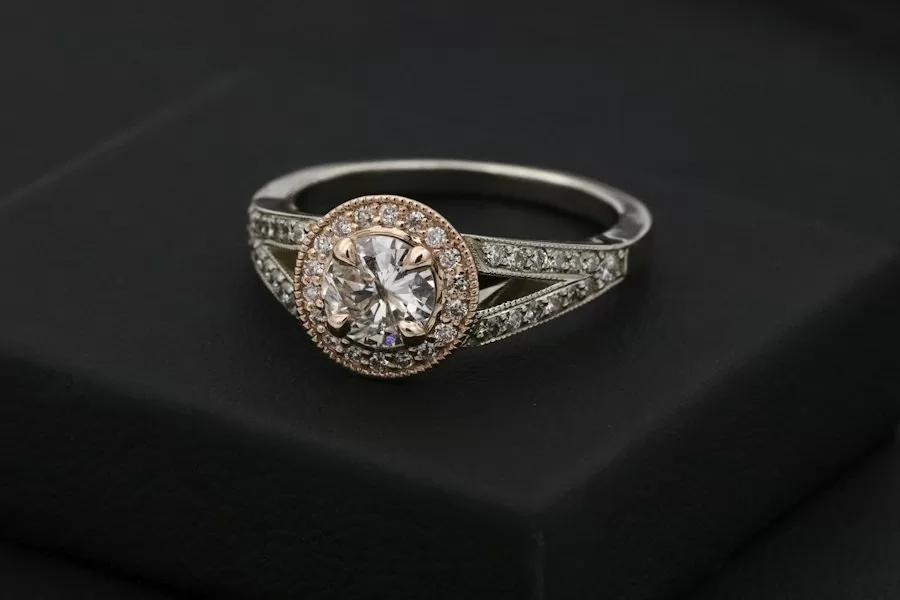
The same 6.5mm stone reads differently on different hands, and staff should set expectations accordingly. On a slender finger, a 6.5mm stone looks proportional and classic. On a wider finger, the same stone can look modest, and the customer may actually prefer a 7.5mm. A thin band makes the stone look larger; a wide band eats visual space around it. Experienced retailers let the customer try the stone on over a plain band that matches her intended setting, so the size decision is made on her hand rather than on a display stand. This small step prevents the common complaint that the ring looked bigger in the case.
It also prevents over-ordering. Once staff understand that visual size depends on finger and band width, they stop reflexively upsizing every customer to the largest stone and instead recommend the size that fits. That honesty builds trust, and trust is what brings the referral bride through the door next.
Fancy shapes follow the same logic
Oval, pear, cushion and emerald-cut moissanite also ship in calibrated millimeter sizes, but their carat equivalent is described by length by width—for example a 7x5mm oval reads as roughly a one-carat diamond equivalent, while an 8x6mm oval reads as about 1.5ct. Always quote the millimeter dimensions to the setter and the visual equivalent to the customer, and never promise a weight that was never the unit of sale.
Train the team once, sell consistently
The most common moissanite mistake in retail is a salesperson improvising a carat number. Print the chart, post it, and make this is a 6.5mm, it reads like about a one-carat diamond the default line. Staff who speak millimeters sound informed and precise; customers who hear a familiar carat equivalent still get the reference they came in wanting. Both leave happy, and your reorders land in the correct calibrated sizes—no returns, no surprises, no awkward conversations.
Authoritative References
For buyers who need to verify the technical and regulatory basis of this guide, the following independent institutions publish authoritative reference data:
- GIA Gem Encyclopedia - independent grading and identification reference for natural and lab-grown gems.
- Wikipedia: Moissanite - peer-reviewed background on moissanite chemistry, optics and history.