Moissanite
Moissanite Rings for Men: Wholesale Opportunities Retailers Miss
Most moissanite assortions target women, but grooms and self-purchasing men are an underserved niche with strong margins. Here is how to buy men's moissanite rings wholesale.
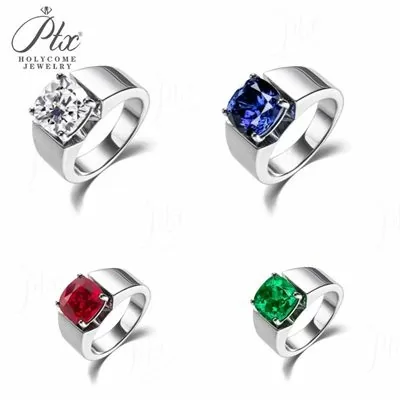
The men's moissanite ring category is small because no one stocks it, not because no one buys it. Grooms walk into jewelry stores expecting to choose between plain tungsten bands, carbon fiber, and titanium, and most settle for a metal they do not really want because the alternative is a diamond priced out of reach. A well-built men's moissanite band undercuts that diamond price tag by a wide margin and gives a groom something with actual sparkle. For a retailer, this is a low-competition niche with clean margins. The wholesale buying decisions are straightforward, and most of them come down to width, finish, and stone placement.
The widths that feel right on a man's hand
Men's rings run wider than women's. The standard wedding band width is 6 mm, with 8 mm as the bold alternative and 4 mm as the slim option. Buy 6 mm as your core; it flatters most hands and does not crowd the knuckle. The 8 mm version looks good on larger hands but returns more often for "too wide." The 4 mm version sells to slimmer hands and to men who want a discreet band. A first order should lean heavily on 6 mm.
Stone placement: channel set wins
A men's moissanite ring with prong-set stones around the outside looks like a women's band worn by a man, and it reads as mismatched. The style that works is a channel-set row of small moissanites across the top of the band, or a single bezel-set stone on a brushed band. Channel set keeps the stones smooth against the skin and avoids the "I caught my ring on a door handle" complaint. Bezel-set solitaires in a brushed silver or gunmetal finish have a strong self-purchase following among younger men who want a piece with personality but not a diamond price.
Finish matters more than carat
A shiny polished men's band reads as dressy; a brushed or matte finish reads as everyday. Most grooms and self-purchasing men prefer brushed because it hides scratches. Ask your supplier for a brushed finish on the 6 mm channel band. A black-rhodium dip over the silver gives a gunmetal look that has trended for several seasons and sells to younger buyers. Avoid polished high-gloss unless you specifically cater to formalwear customers.
Metal choices
925 sterling silver with black or white rhodium is the price leader. Stainless steel is more durable but cannot be plated with moissanite settings as cleanly; most stone-set men's bands ship in silver. For grooms who want a heavier feel, some suppliers offer silver cores with a tungsten-look exterior, but those cannot be resized and should be made-to-order rather than stocked. Our silver versus stainless steel comparison covers the durability tradeoff.
Pricing and margin
A 6 mm channel-set moissanite band has a low wholesale cost and retails in the $120 to $250 range, which is squarely in the "groom will buy this without a long conversation" band. Compare that to a men's diamond band, which starts near $1,000, and the value story writes itself. The margin is comparable to women's bands, and the competition is thinner. For more on how bridal pricing layers across the set, our boutique bridal program article covers the attach math.
How to display men's rings
Most boutiques bury men's rings in a drawer. They sell far better on a dedicated stand at the side of the bridal case, where grooms can try them on while the partner looks at engagement rings. Display the brushed channel band next to a plain comfort-fit band so the groom can compare. A hand model or a male mannequin hand helps; men buy jewelry they can picture on themselves, and a women's hand in the photo hurts conversion.
Sizing
Men's ring sizes run 8 to 12, with size 10 and 11 being the most common. Stock those two sizes deep and hold 9 and 11.5 as secondary. Size at point of sale; silver bands resize cleanly. Do not stock full-eternity styles for men because sizing a full-eternity band is impractical, and grooms resize more often than you expect.
Disclosure and trust
Men who walk in expecting a diamond will ask directly. Be upfront that the stone is moissanite, explain the hardness and the price difference, and the sale usually closes. Mislabeling a moissanite ring as a diamond on a groom's finger is the fastest way to lose a customer who will eventually show the ring to a jeweler. Our retail staff training guide has the exact scripts.
Start with two SKUs
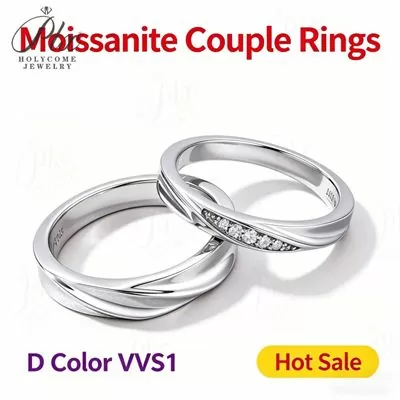
Open with one brushed 6 mm channel band in silver and one bezel-set solitaire in gunmetal. Watch which one gets tried on more. The channel band will likely move first because it pairs with a bride's band as a matching set. Reorder that width and finish before expanding into 8 mm or two-tone styles.
The men's moissanite ring is a niche with thin competition and a clear value story. Buy the right width, choose the brushed channel finish, display it where grooms can reach it, and it becomes the attach sale you did not know you were missing.
Authoritative References
For buyers who need to verify the technical and regulatory basis of this guide, the following independent institutions publish authoritative reference data:
- GIA Gem Encyclopedia - independent grading and identification reference for natural and lab-grown gems.
- Wikipedia: Moissanite - peer-reviewed background on moissanite chemistry, optics and history.